|
|
 07-02-2009, 11:21 PM
|
#1
|
|
Senior Member
Join Date: Oct 2008
Location: Tennessee
Posts: 267
SUN #1632
|
A few mods (changes) in Stinky
After camping locally and the trip to Buttonwood and then NY, we decided to make a few changes to eliminate the clutter and give us more storage space.
We let down the unused bunk which when up was a rather shallow space hard to reach over the bed. The bed is always set up since it's such a hassle to make it nightly. This gave us loads of space for storing light stuff that is much easier to reach. We can set the TV up on the shelf and watch it from the dining area. I made a curtain that opens in the middle to hide the stored stuff.  Scroll down.
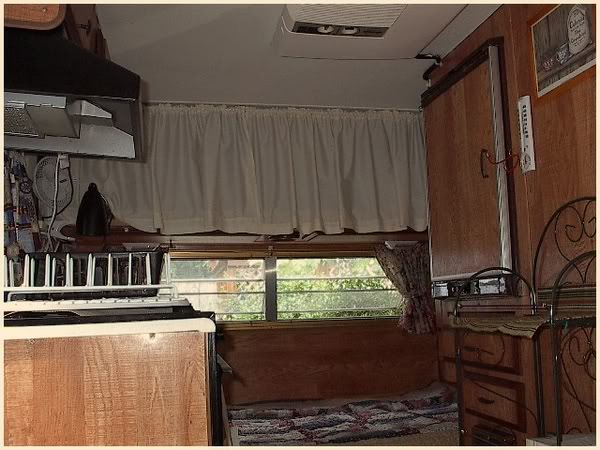
A "clip-on" light and fan from Wally World keeps them out of the way and I can read in bed. A huge cutting board on "no-slip" shelf liner covers the stove burners.
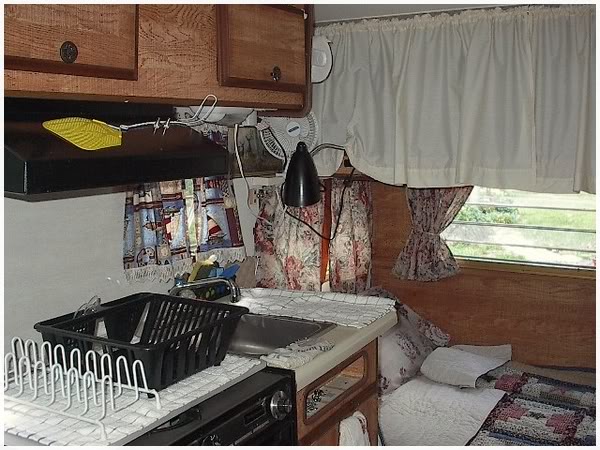
I love this bakers rack. It's so handy for anything, from a towel for after showering to a loaf of bread or box of DVDs. It's screwed to the wall and small bungie cords hold things in place when on the road. Also, an extra long shower curtain was added to keep water from escaping onto the floor in the cabin. The curtain that came with Stinky was too short. Velcro holds the shower curtain in place when showering.
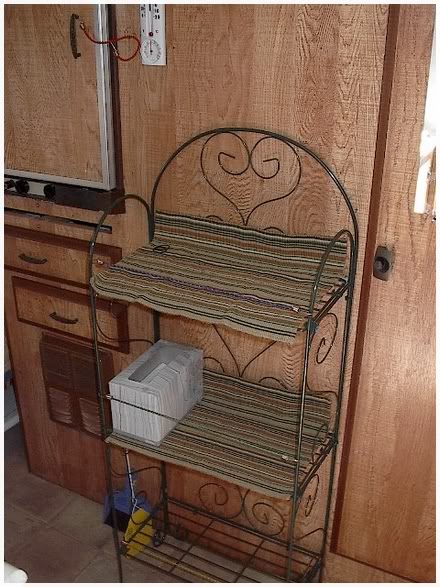
The space under the bed was a cluttered mess. Now the dishpans are off to the left and I bought a clear storage box for the right side. Now I can see what's under there and pull it out easily. Open space under bed will be for shoes. Fly swatter is back in place.

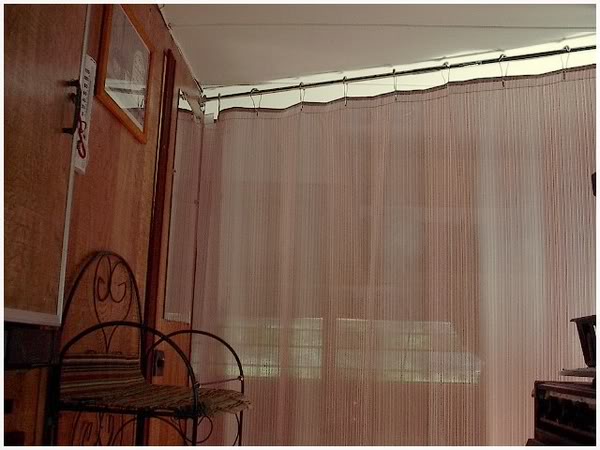
We added a "curtain" across at an angle. This gives me privacy after a shower to dress and dry off without having to close all the curtains up front. It also allows my husband to leave and enter without anyone seeing in. It allows the bathroom door to stay open when using the toilet. It also allows the door to stay open when we nap. The door being open really adds to keeping the TT cool. Curtain is partway closed here.
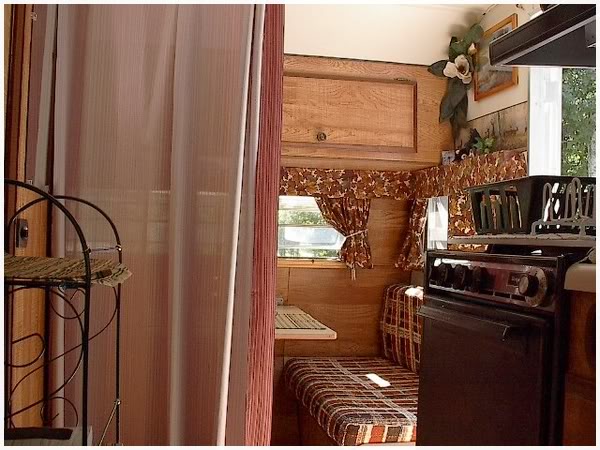
Fully closed dividing the cabin in two.
__________________
|

|

|
|
07-03-2009, 11:08 AM
|
#2
|
|
Senior Member
Join Date: Nov 2006
Location: New York
Posts: 2,909
SUN #93
|
So I have to ask....is Stinky still Stinky???? Or is she all better now???
Cute mods - and very usefull use of space....like the drop down bunk with curtain idea a lot.
__________________
__________________
Kathy & Leo SUN 093
Central Adirondacks of New York
2013 Rubicon 2900 Toy Hauler
We loved our 2007 T-2499
2010 Ford F-350 4x4 Lariat Super Crew Dually Diesel

|
|
|
|
|
07-03-2009, 12:17 PM
|
#3
|
|
Senior Member
Join Date: Oct 2008
Location: Tennessee
Posts: 267
SUN #1632
|
Quote:
|
Originally Posted by Poppy & Nana
So I have to ask....is Stinky still Stinky???? Or is she all better now???
Cute mods - and very usefull use of space....like the drop down bunk with curtain idea a lot.
|
Hi Nana and Poppy.
The smell from the old leaking sewer tank is completely gone. It took almost a month. The funky smell around the sink was traced to the new counter top the last owner installed before selling Stinky. A small leak at the back of the counter, where it met the wall, was adding to the smell. The faucet leaked and a small amount of water would go down the crack. Since that's been fixed the smell is very faint. I can only hope it completely goes away in time. It must be from the glues used in the counter top.
__________________
|
|
|
|
|
07-06-2009, 01:59 PM
|
#4
|
|
Moderator
Join Date: Nov 2006
Location: Ohio
Posts: 12,654
SUN #89
|
Nice home touches. It does not take much to make a big difference.
Thanks for sharing and glad Stinky is now not so Stinky any more.
John
__________________
Current Sunlines: 2004 T310SR, 2004 T1950, 2004 T2475, 2007 T2499, 2004 T317SR
Prior Sunlines: 2004 T2499 - Fern Blue
2005 Ford F350 Lariat, 6.8L V10 W/ 4.10 rear axle, CC, Short Bed, SRW. Reese HP trunnion bar hitch W/ HP DC
 Google Custom Search For Sunline Owners Club
|
|
|
|
|
07-07-2009, 05:06 AM
|
#5
|
|
Moderator
Join Date: Dec 2006
Location: Pennsylvania
Posts: 2,285
SUN #128
|
Nice ideas. Looks like she's getting customized nicely 
__________________
Pam
Lance 1475 "Snoopy"
2012 GMC Sierra 3500HD 4x4 D/A
2012 Arctic Fox 30U, SUNLINES - 2006 2753 "Tweety", 2007 QUE "QUEtSE", 2364, 1660
|
|
|
|
|
07-09-2009, 04:43 PM
|
#6
|
|
Senior Member
Join Date: Oct 2008
Location: Tennessee
Posts: 267
SUN #1632
|
We just got back from 2 days/nights at Land-Between-The-Lakes. We stayed at Piney Woods CG. We have storage space to spare now.
We got our Senior Pass while there. We're also considering some dry camping. A few changes will be made should be do that, such as taking potato and macaroni salad and cold slaw instead of cooking on the hot plate and creating pots and lids to wash. Meat can be cooked on the Hibachi. Disposable paper plates and plastic "silverware" will be used. A minimum of water would be needed. From what I've seen so far the nicest parts of many CGs are the areas without hookups. They're also the least crowded and have the best views. At Piney Woods, that section, right on the lake, was almost empty. It was also in deep shade. Something needed here in the south. You fill your tank at one of the spigots and dump your tanks either on the way out, or use a Blue Boy (rolling Honey Bucket). It was 125 miles from where we live.
__________________
|
|
|
|
|
07-10-2009, 07:25 AM
|
#7
|
|
Moderator
Join Date: Dec 2006
Location: Pennsylvania
Posts: 2,285
SUN #128
|
It's true that often the dry camping spots are the most spacious and scenic. With your small trailer you'll be able to get into some of the best spots! When we traded the QUE for the Tweety we really gave up some options as far as campsites in the pubic parks. Besides taking prepared food along, the other trick I use is that I have 2 Rubbermaid dish pans and wash/rinse dishes on the picnic table. That keeps the dish water out of the holding tank.
__________________
Pam
Lance 1475 "Snoopy"
2012 GMC Sierra 3500HD 4x4 D/A
2012 Arctic Fox 30U, SUNLINES - 2006 2753 "Tweety", 2007 QUE "QUEtSE", 2364, 1660
|
|
|
|
|
07-10-2009, 04:33 PM
|
#8
|
|
Senior Member
Join Date: Oct 2008
Location: Tennessee
Posts: 267
SUN #1632
|
Quote:
|
Originally Posted by Tweety
It's true that often the dry camping spots are the most spacious and scenic. With your small trailer you'll be able to get into some of the best spots! When we traded the QUE for the Tweety we really gave up some options as far as campsites in the pubic parks. Besides taking prepared food along, the other trick I use is that I have 2 Rubbermaid dish pans and wash/rinse dishes on the picnic table. That keeps the dish water out of the holding tank.
|
Hi Tweety. I was told it's illegal to dump gray water on the ground. I haven't seen any signs but felt it was some kind of law or rule. Has anyone ever said anything to you for doing it? I have two dishpans I carry with us but only used them once.
I'm hoping to do "something" since I don't care to have no choice in some campgrounds but to park away from the lakes or rivers and have only other campers as my view or no or only partial shade. LBL was a nice CG but we had a spot with nothing to look at but the other campsites. There was no privacy at all. Then we walked down to the area with no hookups and saw all the beauty and space and shade and all right on the water. The same thing at the Cooperstown CG in NY. Since we spend most of our time at the campsite, I would rather give up the conveniences of complete hookups and have a nice view with some space around us.
__________________
|
|
|
|
|
07-10-2009, 04:53 PM
|
#9
|
|
Moderator
Join Date: Dec 2006
Location: Pennsylvania
Posts: 2,285
SUN #128
|
I guess watering a tree with dish water is a holdover from our tenting days. (& also what most tenters still do) We've never had anyone say anything. You could walk it to the bathroom and dump it in the sink if it isn't too far. It probably is illegal or at least taboo to be dumping a holding tank of gray water, but splashing a half gallon of dish water on a tree seems harmless
__________________
Pam
Lance 1475 "Snoopy"
2012 GMC Sierra 3500HD 4x4 D/A
2012 Arctic Fox 30U, SUNLINES - 2006 2753 "Tweety", 2007 QUE "QUEtSE", 2364, 1660
|
|
|
|
|
07-10-2009, 08:00 PM
|
#10
|
|
Moderator
Join Date: Nov 2006
Location: Ohio
Posts: 12,654
SUN #89
|
Hi Folks
A few comments on the gray water topic. Using the words “illegal” are pretty strong for this and each state may have something on the books about it so if in serious doubt in the area you are in, call the local Dept of Env. Conservation. Note I was referring strictly to the act of being illegal.
I have not “yet” seen a state park where a park “rule” does not exist making it against park policy to only dispose of gray water in the appropriate place. All Ohio state parks have a dumping spot every so often between camp sites. I have also seen this in the Provincial parks of Canada. Some are concrete block with a drain hole in the middle, others are level with the ground and contain crushed stones with a large metal pipe surrounding them to make a drain pit. Some of the pipe ones drain into actual tanks underground and then into a leach field. Others are just stone drain ways under ground. The end result is that the gray water from campers is disposed of in a concentrated place where it has minimal impact on the area in high use camping locations.
The problem with gray water is most people have all kinds of things in gray water. Chucks of food, heavy dish soaps, non biodegradable soaps and then there is the distance from fresh water ways issues. If the park services did not have rules and did not provide a dumping location, many campers would not practice low impact camping guidelines as they may not ever have heard of them. Things would be dumped every where. Ants go after the food and so do animals. Now nature is taking over and right on top of your campsite.
The Boy Scout hand book has guidelines of low impact camping and uses different guidelines for different areas. In bear country they are extremely strict on purpose and by design about what gets placed where by humans. Smellables are a big deal when you have 20,000 Scouts come thru and area every year. Even duct tape is considered a smellable and is to be hung in a bar bag every night. At the large use Scout camps in bear country, they have pipes in the ground to a leach field drain similar to the State Parks for gray water and that is “After” you have strained the water for food particles that get packed out back to base camp in a yum yum bag. (Yes after a few days of 90 F heat that bag turns all kinds of colors….) This is to keep all smellables from gray water out of the way of bears. The other list of bear essential camping goes on but this is the gray water part.
If you are at base camp in a non bear area of the wilderness you dig a hole in the ground and dispose of the gray water away from fresh water supplies and cover the hole over when you leave camp. This is when you made your own campsite.
If you are only camping 1 night (again in non bear country), you strain out all food out and if a small qty of water, you give it a fling to disperse it over a large area to minimize impact a good distance away from where fellow campers are camping. Again only using biodegradable soap. This is used in areas where there are no prior rules and in open back country.
Even with our big TT we still have 3 dish tubes and when we have a big pile of dishes we do it the old way using the tubs. I wash, Cindy dries. Then we go dispose of it in the gray water pit at camp. Key is to think low impact. What does sort of boil me is campers who dump gray water where ever they feel like when the dump ring is 1 camp site away or worse right in front of there camp site…..  They never thought about what they where doing and what came come from it.
If a Ranger sees you fling gray water where ever and the park has rules, I’m sure they will come visit with you and explain the rules.
Practice low impact camping, take only memories and leave only foot prints.
Hope this helps explain some of this. Sorry if I got long winded, after living and breathing low impact camping and living it, anything less is really hard for me to do. The worst is seeing trash in the campsite. This to me is totally inexcusable.  OK I’ll get off my soap box now.
Go find one of those great non electric sites and have fun. They are generally better camp sites.
John
__________________
Current Sunlines: 2004 T310SR, 2004 T1950, 2004 T2475, 2007 T2499, 2004 T317SR
Prior Sunlines: 2004 T2499 - Fern Blue
2005 Ford F350 Lariat, 6.8L V10 W/ 4.10 rear axle, CC, Short Bed, SRW. Reese HP trunnion bar hitch W/ HP DC
Google Custom Search For Sunline Owners Club
|
|
|
|
|
07-10-2009, 09:30 PM
|
#11
|
|
Senior Member
Join Date: Feb 2008
Location: Pennsylvania
Posts: 201
SUN #520
|
We too do our dishes in a basin but dump the water down the toilet for several reasons. The black water tank never fills up and the extra water dumped in it helps prevent the "cone of poop" and helps clean out the tank better when you go to the dump station. This saves more space in the grey water tank for things like showers! We also have a 2 qt measuring cup that we run the water into in the morning while waiting for the hot water to make its way to the bathroom from the hot water tank. This water is then used to rinse dishes later in the day.
kathyh
__________________
2007 Sunline T2499 4" lift w/03
2011 Chevy Avalanche
1988 Sunline 1850 Satellite
Rob and Kathy H
|
|
|
|
|
07-11-2009, 09:14 AM
|
#12
|
|
Member
Join Date: May 2009
Location: New York
Posts: 90
SUN #864
|
I'm loving this thread about low impact camping in a TT! It should be a separate topic for tips. We come from dry camping in a popup and our first trip out will be with full hookups just to experience it, but after that we love our NYState public campgrounds and it's definitely dry camping but beautiful, so we'll continue. Any of you use generators when you dry camp?? How long do the lights usually last on the battery??
__________________
Nancy and Pat
2006 T-1950
2007 Dodge Ram 1500 with a "Hemi!"
|
|
|
|
|
07-11-2009, 09:46 AM
|
#13
|
|
Senior Member
Join Date: Apr 2007
Location: New York
Posts: 1,846
SUN #264
|
Quote:
|
Originally Posted by Nancy G.
I'm loving this thread about low impact camping in a TT! It should be a separate topic for tips. We come from dry camping in a popup and our first trip out will be with full hookups just to experience it, but after that we love our NYState public campgrounds and it's definitely dry camping but beautiful, so we'll continue. Any of you use generators when you dry camp?? How long do the lights usually last on the battery??
|
Many of us have generators. The preference is for the quitest ones possible like the Honda 1000 and 2000 and the same size Yamaha's. Any thing bigger is too heavy to move around. The cheap generators are all noisy, and are very annoying to your neighbors for several sites in both directions. In June, we were 3 sites away from one, and you had to get within 15 feet or so of our generator before you could hear ours running.
NYS parks allow 5 hours of generator use a day: 9-11 in the morning and 4-7 in the afternoon.
How long the will last is impossible to predict as there are too many factors. The charge in the battery, the number and type of lights you use and how long you use them, use of furnace in spring and fall, etc. It also matters how much you charge up the battery each day.
We are moderately economical on light useage. I have swapped out some of the 921 bulbs for 194's. They are dimmer but use a lot less juice. We also bought a 3-pack of the LED stickup lights and use them. Their AAA batteries will last a whole season or longer.
Some folks have dual batteries or 6 volt golf car batteries so they tend to last longer before needing a charge.
There are a bunch of great tips on 12volt conservation on here. Do a search on boondocking and you will find several discussions that are very comphrensive on the the subject.
__________________

'12 F250 4x4 Super Duty PowerStroke 6.7 diesel
2011 to present: '11 Cougar 326MKS
1999 to 2011: '99 Sunline T-2453
SUN264 * Amateur Radio kd2iat monitoring 146.52
|
|
|
|
|
07-11-2009, 11:42 PM
|
#14
|
|
Senior Member
Join Date: Oct 2008
Location: Tennessee
Posts: 267
SUN #1632
|
Quote:
|
Originally Posted by Tweety
I guess watering a tree with dish water is a holdover from our tenting days. (& also what most tenters still do) We've never had anyone say anything. You could walk it to the bathroom and dump it in the sink if it isn't too far. It probably is illegal or at least taboo to be dumping a holding tank of gray water, but splashing a half gallon of dish water on a tree seems harmless |
I believe it is harmless... however, we went to check out Poole Knobs on the lake today. It's the next place we plan to camp at and it's close to where we live - about 20 minutes away. Since the CG was full, she could not let us in to check it out. The lady did give us some literature. It mentions dumping graywater on the ground is *not* allowed.  It must to taken to a dump station at the park. Maybe too many people were doing it and dumping it right in the campsite instead of in the woods or in the weeds/grass. That could be a smelly mess after a few days. I have an old milk can with a carry handle that holds a gallon of liquid. It just may come in handy again.
__________________
|
|
|
|
|
07-12-2009, 12:12 AM
|
#15
|
|
Senior Member
Join Date: Oct 2008
Location: Tennessee
Posts: 267
SUN #1632
|
Quote:
|
Originally Posted by JohnB
Hi Folks
Practice low impact camping, take only memories and leave only foot prints.
(Brevity snipped)
John
|
This is how I feel also. Isn't there an old Indian saying to leave only your footprints behind? I haven't seen those graywater pits you mentioned. Apparently here in TN the graywater must be taken to the sewer dump sites. This is the first brochure (from Poole Knobs TN) that mentions graywater cannot be dumped on the ground.... or the first I've noticed. This is a COE CG. We have noticed that campers before us at several CGs have left trash in the fire pits, cigarette butts all over the sites and what looked like graywater leavings (bits of food) in the fire/BBQ pits as well. This last site came complete with a few plastic junk food bags amongst the cigarette butts the last camper left behind.

Similar to this was the man next to us at LBL CG this last week who was burning stinky garbage in the BBQ pit. The stench of burning plastics and who-knows-what toxic trash kept floating through our CS (campsite). The dumpster was a 2 minute walk from his camper. He could have tossed a trash bag to it. 
Another gripe about an unhealthy thing are those who let their campfires smolder for hours. One night as I lay in bed trying to fall asleep, I was about to choke from the smoke from smoldering CFs (campfires). I looked out the window to see a smoky haze in the still night air. I was afraid the shrill piercing smoke alarm would go off in my TT any minute. I couldn't see anyone around at 2 AM so why were these fires still smoldering? Why can't people dump some water on them and put them out rather pollute the air?
Those more remote CSs with no hookups are looking better and better to me as we do more and more camping.
Rant over........ 
__________________
|
|
|
|
|
07-12-2009, 09:21 AM
|
#16
|
|
Moderator
Join Date: Dec 2006
Location: Pennsylvania
Posts: 2,285
SUN #128
|
John B...having also been involved in Scouting for years, I believe that we do as you discribed with dishwater. (although we don't strain it we use a papertowel to wipe them before washing them) I need to be more careful with explaining things. Usually we have the tank capacity to hold all our dishwater, but can understand someone with a 1550 not having that capacity needing an alternative. Usually the bathouse has an outdoor sink for dish water disposal, but we have been at campgrounds that only have outhouses.
__________________
Pam
Lance 1475 "Snoopy"
2012 GMC Sierra 3500HD 4x4 D/A
2012 Arctic Fox 30U, SUNLINES - 2006 2753 "Tweety", 2007 QUE "QUEtSE", 2364, 1660
|
|
|
|
|
07-12-2009, 10:53 AM
|
#17
|
|
Senior Member
Join Date: Jun 2007
Location: New Hampshire
Posts: 1,025
SUN #292
|
Gray water
It depends.
If we think we're going to be tight for gray water storage in our motorhome, we dump the dish water into the black tank via the toilet. It was stupidly designed with the same size, 50 gallon, grey and black tanks.
This approach is less useful in the 1550 because the black tank is relatively small however we did a test last year and found the black tank was adequate for 6-7 days.
Many people want to live in their trailer like they do at home hence large capacity grey tanks are required. Our approach is to be prudent with our use of water. For casual meals we use paper plates.
If we're in the midst of wilderness in Alaska or Labrador it's hardly harmful to dump gray water. After all what do bears do in the woods?
Dumping dishwater is not like dumping a 50 gallon grey tank.
We're wondering how long we can go without dumping in our 1550. It would be nice to make a week. Actually moving the trailer once a week or so is not that difficult because of its size. One disadvantage/advantage of a small rig is that you don't carry all those extras, like those magic blue tanks.
Now that we've added a shower it will be interesting to see. We're planning a trip to Washington county Maine this August and we'll do some further testing. (Washington county is half the size of Connecticut with a population of 35,000.)
Safe travels,
Norm
__________________
Norm and Ginny Milliard
1982 Sunline 15.5 SB
2004 Honda CRV 4 cyl, manual
|
|
|
|
|
07-15-2009, 10:48 PM
|
#18
|
|
Senior Member
Join Date: Oct 2008
Location: Tennessee
Posts: 267
SUN #1632
|
Quote:
|
Originally Posted by Nancy G.
I'm loving this thread about low impact camping in a TT! It should be a separate topic for tips. We come from dry camping in a popup and our first trip out will be with full hookups just to experience it, but after that we love our NYState public campgrounds and it's definitely dry camping but beautiful, so we'll continue. Any of you use generators when you dry camp?? How long do the lights usually last on the battery??
|
You can always use lanterns if you dry camp. Save your battery. Even a regular kerosene lantern from Wally World gives off enough light to read or play a board game.
__________________
|
|
|
|
|
07-16-2009, 05:29 AM
|
#19
|
|
Senior Member
Join Date: Jun 2007
Location: Pennsylvania
Posts: 312
SUN #307
|
In fact, I wish everyone would go to kerosine/oil lanterns in a campground. Those propane lanterns are so bright and annoying to Sue & I. We just want a little darkness, set by the fire, and let the flickers of the flame erase the worries of the world.
Then a neighbor lights up one or two of those lanterns and the night becomes day...................Oil lanterns give that soft glow that doesn't burn a hole through your retina. Imagine the fun we had last fall setting up across from a field of Boyscouts. Looked like a Walmart parking lot over there 
__________________
Marshall & Sue
2007 T-195SR (Lucky)
1980 Sunspots (Peanut,Pigpen & Penelope)

|
|
|
|
|
07-16-2009, 05:47 AM
|
#20
|
|
Moderator
Join Date: Dec 2006
Location: Pennsylvania
Posts: 2,285
SUN #128
|
Agree on the lantern issue. Then there's the awning lights and Christmas lights issue. Last Christmas our neighbors had BLINKING lights along their awning that they would leave on until late - thank goodness they eventually did turn them off. Couldn't ask the camp hosts to talk to them about it because they WERE the camp hosts Our neighbors behind us here at home have a halogen light that they leave on all night now and then...gives our back yard the WalMart effect. I HATE light.
__________________
Pam
Lance 1475 "Snoopy"
2012 GMC Sierra 3500HD 4x4 D/A
2012 Arctic Fox 30U, SUNLINES - 2006 2753 "Tweety", 2007 QUE "QUEtSE", 2364, 1660
|
|
|
|
|
|
|
Currently Active Users Viewing This Thread: 1 (0 members and 1 guests)
|
|
|
 Posting Rules
|
You may not post new threads
You may not post replies
You may not post attachments
You may not edit your posts
HTML code is Off
|
|
|
 Similar Threads
|
| Thread |
Thread Starter |
Forum |
Replies |
Last Post |
|
Stinky Slinky
|
Poppy & Nana |
Repairs and Maintenance |
3 |
05-01-2010 07:33 AM |
|
Little STINKY :(
|
WandaLust |
Sunline Community |
2 |
05-07-2009 08:16 PM |
|
More Mods
|
kanyonkitty |
Modifications |
19 |
12-03-2008 08:16 PM |
|
2 more mods
|
Tweety |
Sunline Que |
2 |
04-25-2007 07:01 AM |
|
QUE mods
|
Tweety |
Modifications |
1 |
01-03-2007 07:02 AM |
|
|
» Recent Sunline Discussions |
|
|
|
|
|
|
|
|
|
|
|
|
|
|
|
|
|
|
|
|
|
|
|













 Linear Mode